Have you ever been in a conversation where someone says something like, People rarely follow advice case in point, and you just pause for a second thinking, wait… what does that even mean? You’re not alone.
A lot of people first see “case in point” in chats, social media posts, or even speeches and feel a little confused because it sounds formal and slightly legal.
Quick Answer:
“Case in point” means “a clear example that proves something is true.” It’s a formal but commonly used phrase to point out evidence that supports a statement or argument.
In simple words, it’s like saying: “Here’s proof of what I just said.”
🧠 What Does Case in Point Mean in Text?
The phrase case in point is used when someone wants to highlight a specific example that proves or explains a general idea. It helps strengthen an argument by showing real-life evidence.
📌 Meaning in simple words:
It means “here is a perfect example of what I’m talking about.”
💬 Example sentence:
“Many students ignore deadlines—case in point, half the class submitted late assignments yesterday.”
👉 In this sentence, the speaker gives a real example (late submissions) to prove their point.
In short:
Case in point = Clear example = Proof of a statement
📱 Where Is Case in Point Commonly Used?
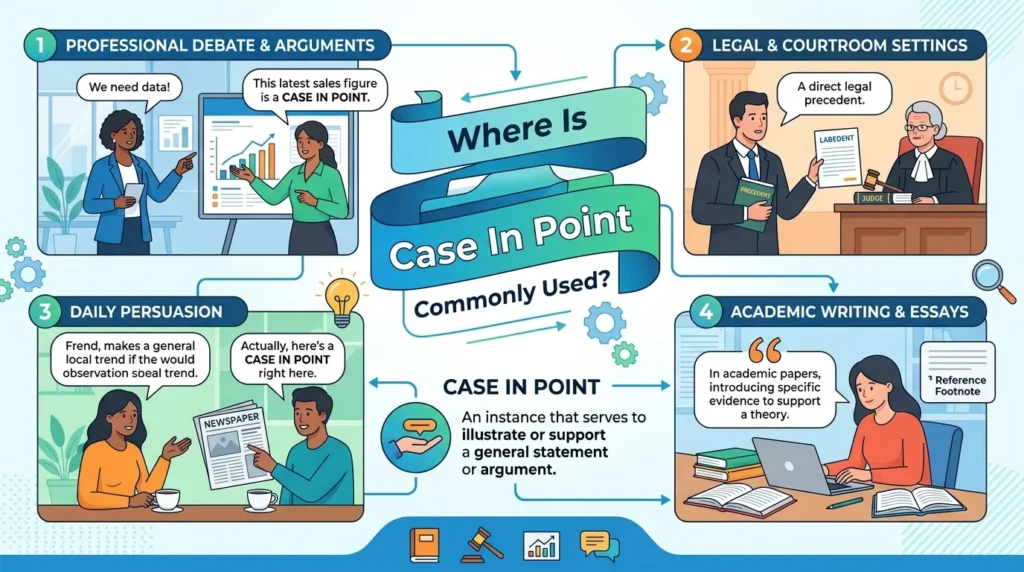
The phrase is not slang, but it is widely used in both formal and semi-formal communication.
📍 You’ll see it in:
- 💬 Texting (when someone wants to explain something clearly)
- 🧠 Essays and academic writing
- 📊 Business discussions and reports
- 📱 Social media explanations or debates
- 🎓 Presentations and speeches
⚠️ Tone:
- Mostly formal or semi-formal
- Sometimes used casually in smart or explanatory conversations
- Not typical teen slang like “lol” or “idk”
💬 Examples of Case in Point in Conversation

Here are some real-life texting-style examples so you can see how it actually works:
A: I think people don’t really listen during meetings.
B: Yeah, case in point, nobody reacted when the manager asked questions 😅
A: Social media affects attention span.
B: Case in point, I can’t even watch a 2-minute video now lol 📱
A: Good habits improve productivity.
B: Case in point, I started planning my day and finished work early today 💯
A: Students procrastinate a lot.
B: Case in point, I’m doing my homework at midnight again 😭
A: Exercise boosts energy levels.
B: Case in point, I feel way more active after my morning walk 🏃♂️
A: People always check their phones too much.
B: Case in point, I’ve checked mine 10 times while writing this 😅
A: Teamwork improves results.
B: Case in point, our group project got an A because we collaborated well 🤝
Case in Point in a Sentence
“Case in point” is an English phrase used to introduce a clear example that supports or proves a statement you have just made. It helps explain an idea by showing a real or specific situation that demonstrates it.
In simple terms, it means “here is a good example of what I just said.” For example, if someone says that exercise improves health, they might add a case in point like a person who started daily walking and became much healthier over time. The phrase is often used in writing and speaking to make arguments stronger and easier to understand by giving direct evidence or illustration.
Case in Point Meaning Origin
The phrase “case in point” originates from formal English legal and academic language, where “case” referred to a specific example or instance used to support an argument or explanation. Over time, it evolved into a common expression in everyday English. The idea behind it is to highlight a particular “case” (example) that clearly demonstrates or proves a point being discussed. Its usage became popular in essays, debates, and speeches because it helps connect general statements with real or specific examples, making arguments more convincing and easier to understand.
A Case in Point Example
“A case in point” is used to introduce a specific example that clearly supports or proves a statement. It helps make an idea easier to understand by showing a real or practical situation that matches what is being explained.
For example, if someone says that reading improves vocabulary, a case in point could be a student who started reading novels daily and quickly improved their English speaking and writing skills. This phrase is commonly used in writing and conversation to strengthen arguments by giving clear and relevant evidence from real-life situations.
Case in Point Plural
The plural form of “case in point” is used when referring to multiple examples that support or prove a statement. While the phrase itself is often kept the same in structure, in meaning it can refer to several “cases in point,” which means more than one clear example used to explain or justify an idea. For instance, in discussions or essays, a writer may present several cases in point to strengthen their argument by showing different real-life situations or evidence. This makes the explanation more convincing and well-supported.
🕓 When to Use and When Not to Use Case in Point
✅ When To Use:
- When giving an example to support your idea
- In explanations or arguments
- In essays, blogs, or discussions
- When you want to sound clear and convincing
❌ When Not To Use:
- In very casual slang chats (can feel too formal)
- In emotional or sensitive messages
- When simplicity is enough
- In quick texting where short words work better
📊 Comparison Table
| Context | Example Phrase | Why It Works |
|---|---|---|
| Friend Chat | “Case in point, I forgot again 😅” | Casual proof of a habit |
| Work Chat | “This trend is increasing—case in point, recent sales data.” | Supports business point |
| “Case in point, previous reports show similar results.” | Professional and clear | |
| Study Notes | “Case in point: photosynthesis improves plant growth.” | Educational explanation |
🔄 Similar Slang Words or Alternatives
While case in point is not slang, there are similar phrases you can use depending on tone.
| Slang / Phrase | Meaning | When to Use |
|---|---|---|
| for example | Giving an example | Everyday conversation |
| e.g. | “for example” (short form) | Writing or notes |
| such as | Listing examples | Formal writing |
| proof is | Showing evidence | Casual speech |
| like this | Simple explanation | Informal chat |
| instance | Specific example | Academic or formal |
❓ FAQs About Case in Point
1. What does case in point mean in simple words?
It means a clear example that proves a statement.
2. Is case in point formal or informal?
It is mostly formal but can be used in casual explanation.
3. Can I use case in point in texting?
Yes, but it may sound a little smart or formal in casual chats.
4. Is case in point slang?
No, it is not slang; it is a standard English phrase.
5. What is another word for case in point?
“Example” or “for instance” are common alternatives.
6. Where do people use case in point most?
In writing, debates, presentations, and explanations.
7. Is it okay to use in exams or essays?
Yes, it is perfect for academic writing.
🧾 Conclusion
To sum it up, “case in point” is a simple but powerful phrase used to support an idea with a clear example.
Whenever you want to prove something you’re saying, this phrase helps you point directly to real evidence.
It’s commonly used in writing, discussions, presentations, and even casual explanations when you want to sound clear and convincing.
Although it may sound formal at first, once you understand it, you’ll notice it everywhere in essays, conversations, and social media posts.
Just remember: if you’re giving an example to prove your point, you’re using case in point correctly.